
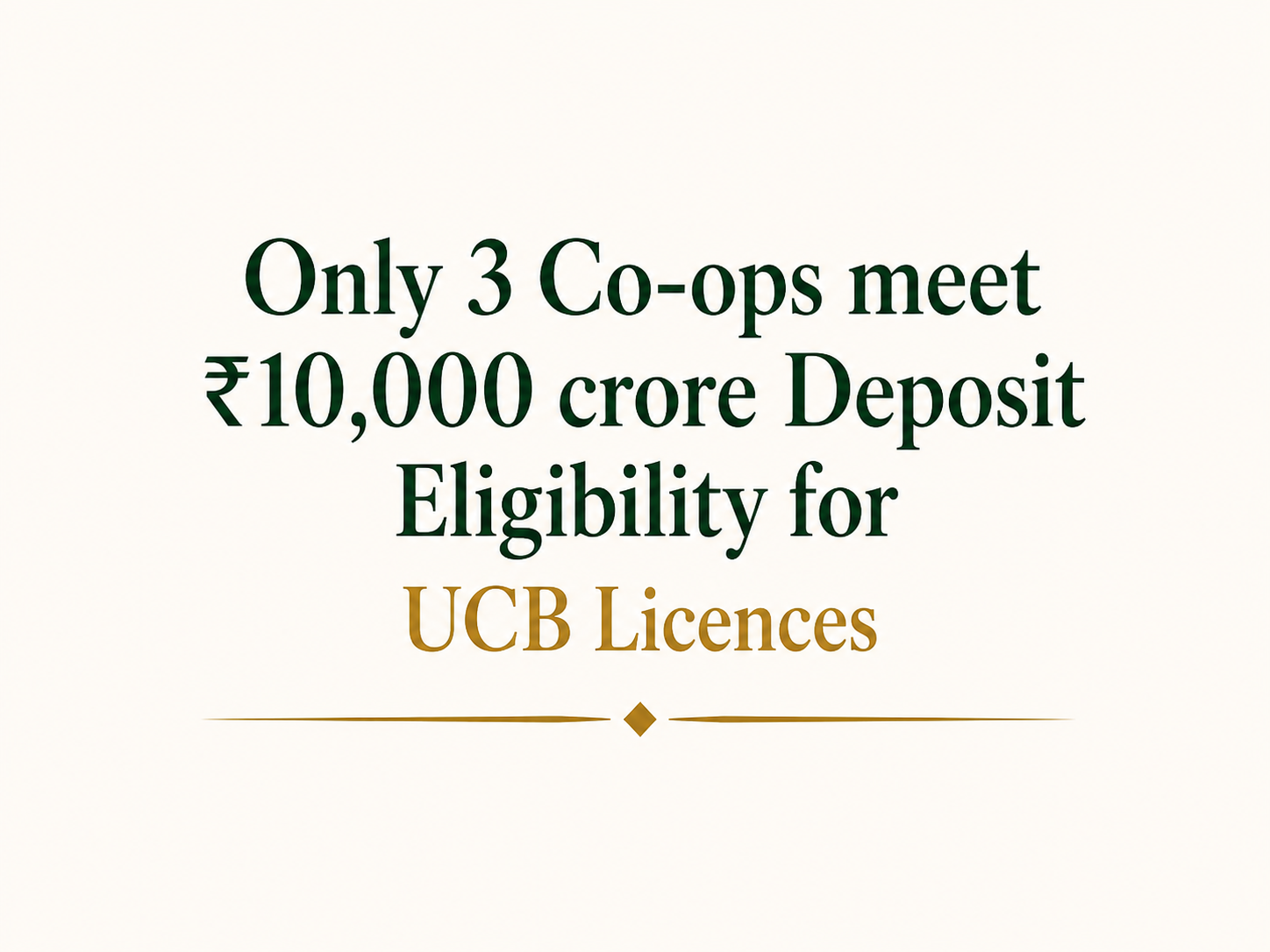
The Reserve Bank of India’s move toward restarting licensing of Urban Co-operative Banks after more than two decades could reshape India’s co-operative banking sector. However, the proposed framework sets a deliberately high entry bar. According to an analysis published by Indian Cooperative on 6 August 2026, only three co-operative institutions currently cross the proposed ₹10,000 crore deposit threshold: Buldana Urban Co-operative Credit Society, Lokmanya Multipurpose Co-operative Society and Repco Bank.
Why the ₹10,000 Crore Threshold Matters
The proposed threshold signals that RBI is looking for scale, stability and institutional maturity before allowing a co-operative entity to enter the banking system. Larger institutions generally have deeper operating histories, broader customer bases, more developed governance systems and stronger capacity to absorb regulatory and technological costs.
The ₹10,000 crore deposit benchmark is therefore not merely a size requirement. It acts as an initial filter intended to identify institutions capable of operating under the more demanding prudential and supervisory standards applicable to banks.
The proposal also reflects RBI’s broader approach to the UCB sector. Licensing of new UCBs had remained paused since 2004 after a significant number of newly licensed banks became financially unsound. RBI’s January 2026 discussion paper noted the importance of adopting stringent entry conditions if licensing were to resume.
Eligibility Goes Beyond Deposits
Crossing the ₹10,000 crore deposit mark alone would not make an institution eligible for a banking licence. The reported draft framework includes several additional prudential and governance conditions.
Key proposed requirements include:
- Minimum net worth of ₹300 crore
- CRAR of at least 12%
- Net NPAs below 3%
- Sound financial and operational performance over the preceding five years
- Compliance with RBI’s fit-and-proper criteria for directors
- A proposed 5% ceiling on individual shareholding
- Strong governance, internal controls and regulatory compliance
Indian Cooperative notes that even an institution satisfying these criteria would not automatically receive a licence. RBI would still assess applications individually through detailed regulatory scrutiny and due diligence.
Who Currently Meets the Deposit Benchmark?
The three institutions identified by Indian Cooperative are:
Buldana Urban Co-operative Credit Society
A large multi-state co-operative credit society with a substantial deposit base and operating presence.
Lokmanya Multipurpose Co-operative Society
Another prominent multi-state co-operative institution whose deposit base exceeds the proposed ₹10,000 crore threshold.
Repco Bank
Established in 1969 and headquartered in Tamil Nadu, Repco Bank also crosses the proposed deposit benchmark and is registered under the Multi-State Co-operative Societies framework.
Their eligibility at the deposit level, however, remains only one part of the overall assessment.
What This Means for Other Co-operatives
For the wider co-operative sector, the proposed norms send a clear strategic message: future banking licences are likely to favour institutions that demonstrate scale alongside sound governance. Smaller co-operative societies may therefore need to focus on strengthening:
- Capital and reserves
- Asset quality
- Governance structures
- Technology and compliance systems
- Internal audit and risk-management practices
- Sustainable deposit mobilisation
The framework may also encourage consolidation among smaller institutions seeking sufficient scale to compete under a stricter licensing environment.
A Shift Toward Quality Over Quantity
The proposed licensing framework represents a significant change in philosophy. Instead of encouraging rapid expansion in the number of UCBs, RBI appears focused on admitting fewer but financially stronger institutions. For co-operative entities aspiring to become UCBs, the opportunity is substantial, but so is the regulatory expectation. The ₹10,000 crore deposit benchmark highlights that scale alone will not be enough. Capital adequacy, clean asset quality, credible governance and institutional resilience will ultimately determine which organisations are prepared for the next phase of India’s Urban Co-operative Banking sector.